Grain-free pet diets have become one of the most debated topics in modern pet nutrition. Marketed as “ancestral,” “biologically appropriate,” or “cleaner,” these diets surged in popularity over the last decade. Many owners believed grains were harmful fillers and that removing them would improve skin health, digestion, allergies, and overall wellness.
However, scientific research over the past several years has revealed a far more complex picture.
While grain-free diets are not inherently dangerous, current veterinary evidence does not support the idea that grains are universally harmful for dogs or cats. At the same time, certain grain-free formulations — particularly those heavily reliant on peas, lentils, chickpeas, and potatoes — have been associated with cases of diet-associated dilated cardiomyopathy (DCM), a serious heart disease in dogs.
This article explores what grain-free diets really are, what research has discovered, where misinformation originated, and how owners can make evidence-based nutritional decisions.
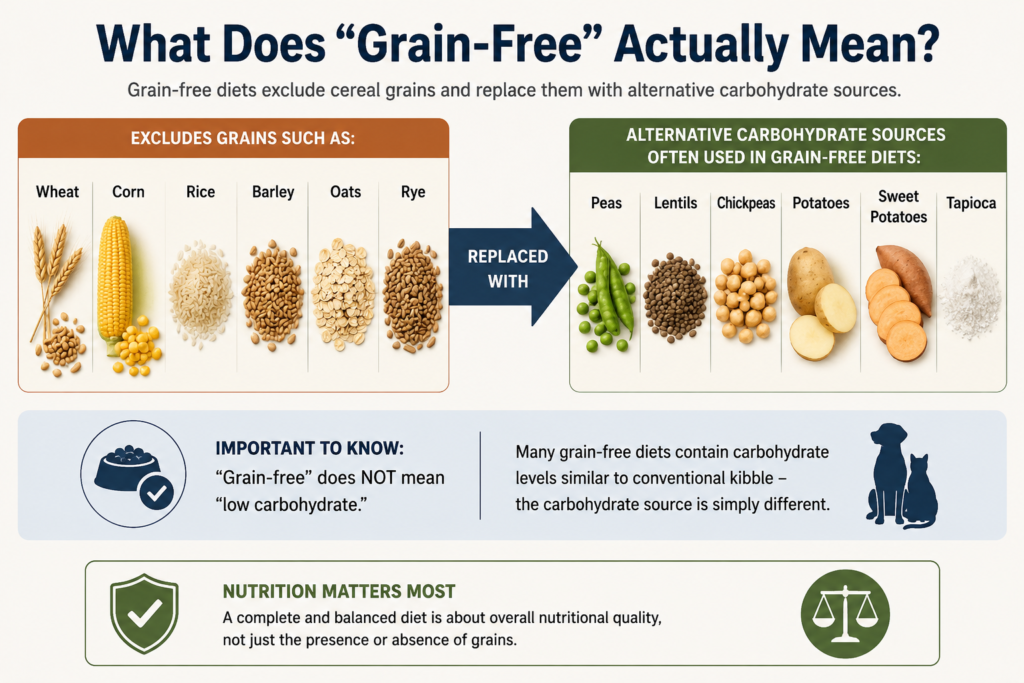
What Does “Grain-Free” Actually Mean?
A grain-free diet excludes cereal grains such as:
- Wheat
- Corn
- Rice
- Barley
- Oats
- Rye
To replace carbohydrates traditionally supplied by grains, manufacturers often use alternative ingredients such as:
- Peas
- Lentils
- Chickpeas
- Potatoes
- Sweet potatoes
- Tapioca
Importantly, “grain-free” does not mean “low carbohydrate.” Many grain-free diets contain carbohydrate levels similar to conventional kibble — the carbohydrate source is simply different.
The Myth That Grains Are “Bad”
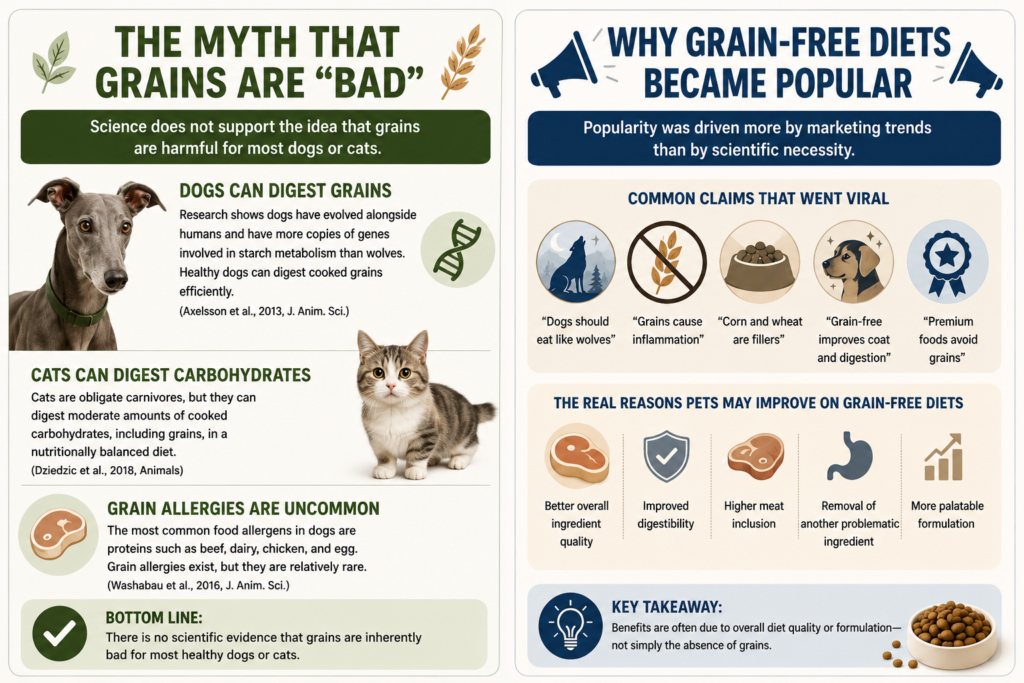
One of the biggest misconceptions in pet nutrition is that grains are biologically inappropriate or harmful.
Current veterinary nutrition science does not support this claim.
Dogs evolved alongside humans for thousands of years and developed genetic adaptations that improve starch digestion. Research has shown that domestic dogs possess increased copies of genes involved in starch metabolism compared to wolves. This means healthy dogs are generally capable of digesting properly cooked grains efficiently.
For cats, the situation differs somewhat because cats are obligate carnivores and require a meat-focused diet. However, even cats can digest moderate amounts of cooked carbohydrates, including grains, when diets are nutritionally balanced.
There is also no evidence that grains are a common cause of food allergies in pets.
Studies consistently show that the most common food allergens in dogs are proteins such as:
- Beef
- Dairy
- Chicken
- Egg
Grain allergies exist but are considered relatively uncommon.
Why Grain-Free Diets Became Popular
The popularity of grain-free diets was driven largely by marketing trends rather than scientific necessity.
Several claims became widespread:
- “Dogs should eat like wolves”
- “Grains cause inflammation”
- “Corn and wheat are fillers”
- “Grain-free improves coat and digestion”
- “Premium foods avoid grains”
While some pets genuinely do better on certain grain-free formulas, this improvement is often due to:
- better ingredient quality overall,
- improved digestibility,
- higher meat inclusion,
- or removal of another problematic ingredient.
It is not necessarily the absence of grains itself causing the benefit.
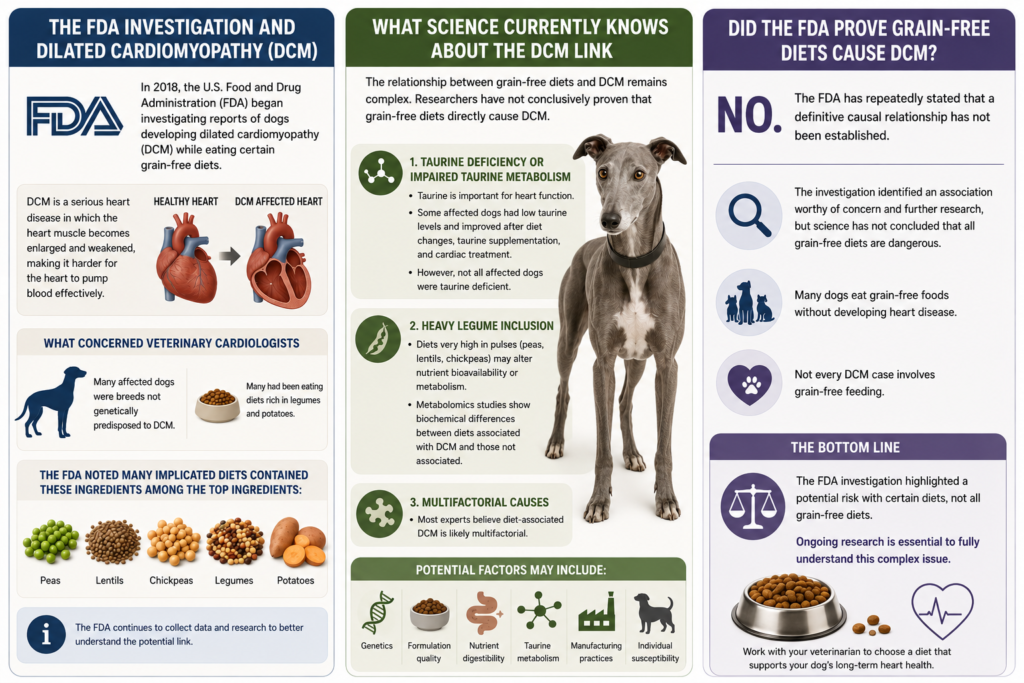
The FDA Investigation and Dilated Cardiomyopathy (DCM)
In 2018, the U.S. Food and Drug Administration (FDA) began investigating reports of dogs developing dilated cardiomyopathy (DCM) while consuming certain grain-free diets.
DCM is a serious heart disease in which the heart muscle becomes enlarged and weakened, reducing the heart’s ability to pump blood effectively.
What concerned veterinary cardiologists was that:
- many affected dogs belonged to breeds not genetically predisposed to DCM,
- and many had been eating diets rich in legumes and potatoes.
The FDA noted that many implicated diets contained:
- peas,
- lentils,
- chickpeas,
- legumes,
- or potatoes among the top ingredients.
What Science Currently Knows About the DCM Link
The relationship between grain-free diets and DCM remains scientifically complex.
Researchers have not conclusively proven that grain-free diets directly cause DCM. However, evidence suggests some formulations may contribute to disease development in susceptible dogs.
Several theories exist:
1. Taurine Deficiency or Impaired Taurine Metabolism
Taurine is an amino acid important for heart function.
Some affected dogs had low taurine levels and improved after:
- diet changes,
- taurine supplementation,
- and cardiac treatment.
Possible mechanisms include:
- reduced taurine absorption,
- altered sulfur amino acid metabolism,
- or increased taurine loss.
However, not all affected dogs were taurine deficient, meaning taurine alone is unlikely to explain every case.
2. Heavy Legume Inclusion
Research suggests diets extremely high in pulses (peas, lentils, chickpeas) may alter nutrient bioavailability or metabolism.
A metabolomics study identified substantial biochemical differences between diets associated with DCM and those not associated with reported cases.
This does not mean legumes are inherently toxic. Rather, excessive reliance on them in poorly balanced formulations may create nutritional imbalances.
3. Multifactorial Causes
Most veterinary researchers now believe diet-associated DCM is likely multifactorial. Factors may include:
- genetics,
- formulation quality,
- ingredient interactions,
- nutrient digestibility,
- taurine metabolism,
- manufacturing practices,
- and individual susceptibility.
Did the FDA Prove Grain-Free Diets Cause DCM?
No.
The FDA itself has repeatedly stated that a definitive causal relationship has not been established.
This distinction is important.
The investigation identified an association worthy of concern and further research, but science has not concluded that all grain-free diets are dangerous.
Many dogs consume grain-free foods without developing heart disease. Likewise, not every DCM case involves grain-free feeding.
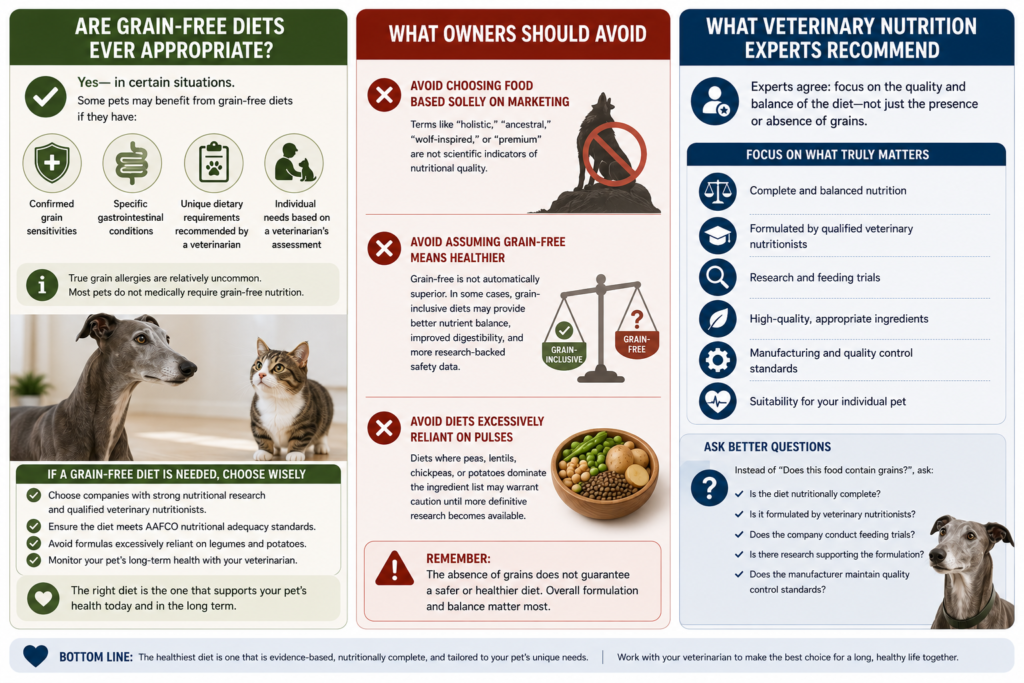
Are Grain-Free Diets Ever Appropriate?
Yes — in certain situations.
Some pets may benefit from grain-free diets if they have:
- confirmed grain sensitivities,
- specific gastrointestinal conditions,
- or unique dietary requirements recommended by a veterinarian.
However, true grain allergies are relatively uncommon. Most pets do not medically require grain-free nutrition.
When grain-free diets are used, veterinary nutritionists generally recommend:
- choosing companies with strong nutritional research,
- ensuring diets meet AAFCO nutritional adequacy standards,
- avoiding excessive legume-heavy formulations,
- and monitoring long-term health carefully.
What Owners Should Avoid
Avoid Choosing Food Based Solely on Marketing
Terms like:
- “holistic,”
- “ancestral,”
- “wolf-inspired,”
- or “premium”
are not scientific indicators of nutritional quality.
Avoid Assuming Grain-Free Means Healthier
Grain-free is not automatically superior.
In some cases, grain-inclusive diets may actually provide:
- better nutrient balance,
- improved digestibility,
- and more research-backed safety data.
Avoid Diets Excessively Reliant on Pulses
Diets where peas, lentils, chickpeas, or potatoes dominate the ingredient list may warrant caution until more definitive research becomes available.
What Veterinary Nutrition Experts Recommend
Most board-certified veterinary nutritionists recommend focusing on:
- complete and balanced nutrition,
- evidence-based formulation,
- feeding trials,
- ingredient quality,
- manufacturing standards,
- and nutritional expertise.
The question should not simply be:
“Does this food contain grains?”
Instead, owners should ask:
- Is the diet nutritionally complete?
- Is it formulated by qualified veterinary nutritionists?
- Does the company conduct feeding trials?
- Is there research supporting the formulation?
- Does the manufacturer maintain quality control standards?
These factors matter far more than whether a food contains rice or oats.
The Bottom Line
The grain-free trend was built partly on marketing myths that portrayed grains as harmful despite limited scientific evidence.
Current research does not support the idea that grains are inherently bad for most dogs or cats. At the same time, evidence suggests some poorly formulated grain-free diets — particularly those heavily reliant on legumes and potatoes — may contribute to diet-associated heart disease in susceptible dogs.
The truth is more nuanced than either extreme.
Grain-free diets are neither universally dangerous nor universally superior.
What matters most is:
- nutritional balance,
- formulation quality,
- scientific validation,
- and suitability for the individual pet.
The safest approach is to choose diets supported by veterinary nutritional science rather than marketing trends.
Reference List
- Axelsson E, Ratnakumar A, Arendt ML, et al.
The genomic signature of dog domestication reveals adaptation to a starch-rich diet.
Nature. 2013;495(7441):360–364.
DOI: 10.1038/nature11837 - Washabau RJ, Day MJ.
Canine and Feline Gastroenterology.
Elsevier Saunders; 2013.
(Referenced regarding digestion and food allergies.) - Freeman LM, Stern JA, Fries R, Adin DB, Rush JE.
Diet-associated dilated cardiomyopathy in dogs: what do we know?
Journal of the American Veterinary Medical Association (JAVMA). 2018;253(11):1390–1394.
DOI: 10.2460/javma.253.11.1390 - Adin D, DeFrancesco TC, Keene B, et al.
Echocardiographic phenotype of canine dilated cardiomyopathy differs based on diet type.
Journal of Veterinary Cardiology. 2019;21:1–9.
DOI: 10.1016/j.jvc.2018.11.004 - Ontiveros ES, Whelchel BD, Yu J, et al.
Development of plasma and whole blood taurine reference ranges and identification of dietary taurine deficiency in Golden Retrievers with dilated cardiomyopathy.
PLoS ONE. 2020;15(5):e0233206.
DOI: 10.1371/journal.pone.0233206 - Quilliam KE, Ren Y, Morris A, Ai Y.
Grain-free pet foods and potential association with canine dilated cardiomyopathy: a review.
Journal of Animal Science. 2021;99(3).
DOI: 10.1093/jas/skab018 - Pezzali JG, Gardner AK, Ferreira GS, et al.
Diet-associated dilated cardiomyopathy in dogs: metabolomics analysis reveals differences in biochemical profiles.
Scientific Reports. 2021;11:6863.
DOI: 10.1038/s41598-021-94464-2 - Fascetti AJ, Delaney SJ.
Applied Veterinary Clinical Nutrition.
Wiley-Blackwell; 2012.
(Referenced regarding taurine metabolism and nutritional balance.)
- U.S. Food and Drug Administration (FDA).
FDA Investigation into Potential Link Between Certain Diets and Canine Dilated Cardiomyopathy.
Updated ongoing investigation and case reports. - American Veterinary Medical Association (AVMA).
Dilated Cardiomyopathy and Grain-Free Diets FAQ. - American College of Veterinary Nutrition (ACVN).
Veterinary Nutrition Resources and Position Statements. - Tufts University Cummings School of Veterinary Medicine.
Petfoodology Blog — Grain-Free Diets and DCM.
Written by board-certified veterinary nutritionists. - AKC Canine Health Foundation.
Investigating Diet-Associated Dilated Cardiomyopathy in Dogs.
- Case LP, Daristotle L, Hayek MG, Raasch MF.
Canine and Feline Nutrition: A Resource for Companion Animal Professionals.
3rd Edition. Mosby Elsevier; 2011. - Hand MS, Thatcher CD, Remillard RL, Roudebush P, Novotny BJ.
Small Animal Clinical Nutrition.
5th Edition. Mark Morris Institute; 2010. - WSAVA Global Nutrition Committee.
Guidelines on Selecting Pet Foods.
World Small Animal Veterinary Association.