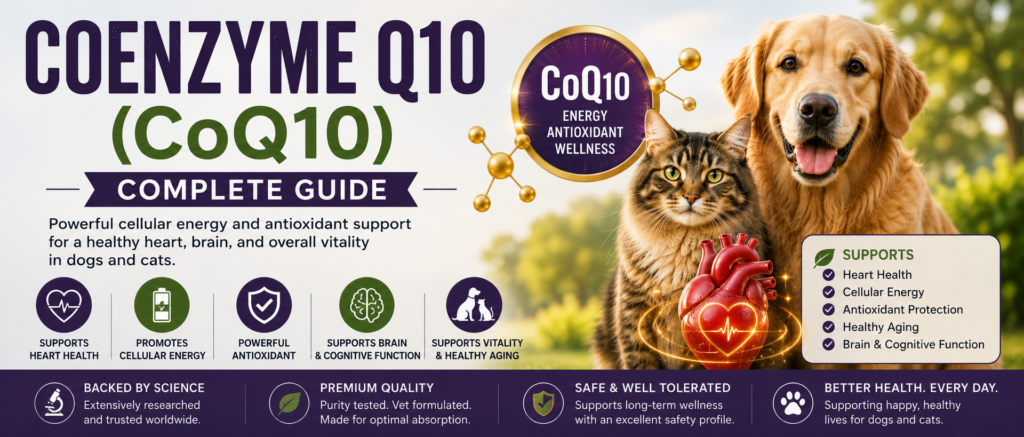
What Is Coenzyme Q10 (CoQ10)?
Coenzyme Q10 (CoQ10), also known as ubiquinone, is a vitamin-like compound naturally produced by the body and found in nearly every cell. It plays a critical role in cellular energy production and acts as a powerful antioxidant that helps protect cells from oxidative damage.
The name “ubiquinone” comes from the word “ubiquitous,” meaning it is found everywhere in the body.
CoQ10 is especially concentrated in organs and tissues with high energy demands, including:
- Heart
- Liver
- Kidneys
- Brain
- Muscles
Because these organs require large amounts of energy to function properly, adequate CoQ10 levels are essential for maintaining normal health and vitality.
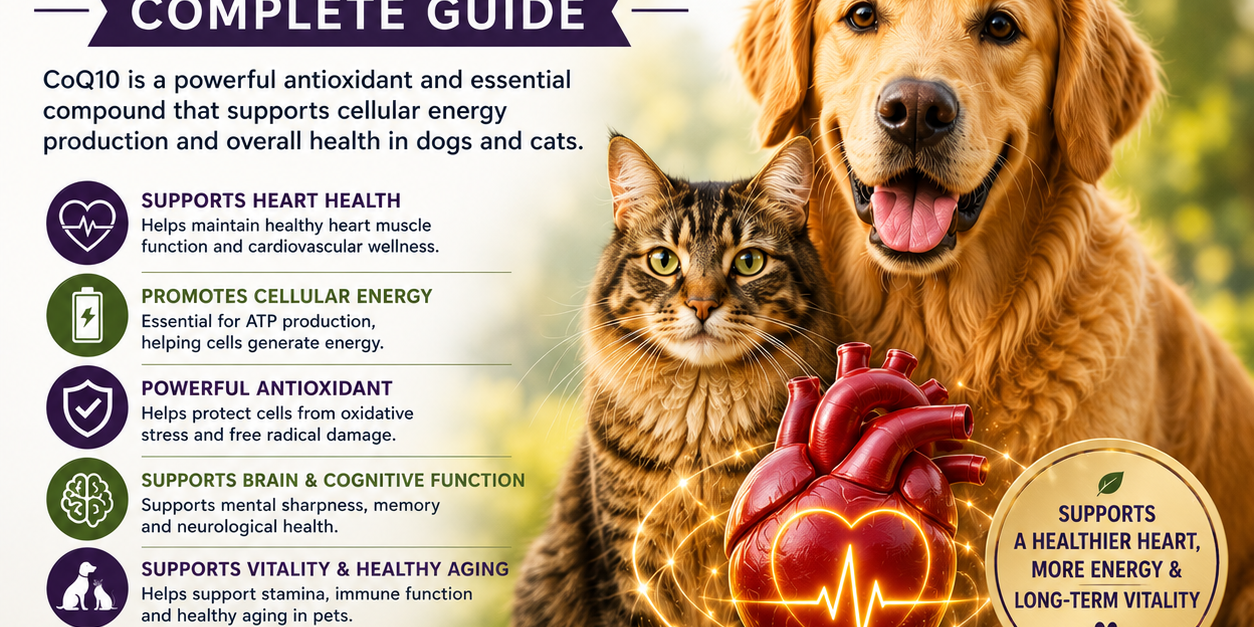
In veterinary nutrition, CoQ10 is commonly used to support:
- Cardiovascular health
- Cellular energy production
- Healthy aging
- Antioxidant protection
- Cognitive wellness
- Overall vitality
As pets age, natural CoQ10 production may decline, making supplementation an increasingly popular component of senior pet wellness programs.
How Does CoQ10 Work?
CoQ10 performs two major biological functions.
1. Cellular Energy Production
Every cell in the body contains structures called mitochondria.
Mitochondria are often referred to as the “powerhouses” of the cell because they generate adenosine triphosphate (ATP), the body’s primary energy currency.
CoQ10 is an essential component of the mitochondrial electron transport chain, where ATP production occurs.
Without adequate CoQ10:
- Energy production becomes less efficient
- Cellular performance may decline
- High-energy tissues may become more vulnerable to stress
This is why CoQ10 is particularly important for organs such as the heart and brain.
2. Antioxidant Protection
CoQ10 also functions as a potent antioxidant.
Antioxidants help neutralize free radicals, unstable molecules that can damage:
- Cell membranes
- Proteins
- DNA
- Mitochondria
Oxidative stress is associated with aging and numerous chronic health conditions.
By helping neutralize free radicals, CoQ10 supports long-term cellular health.
3. Supports Cardiovascular Function
The heart requires enormous amounts of energy.
Because heart muscle cells contain high concentrations of mitochondria, they also contain high levels of CoQ10.
CoQ10 helps support:
- Normal cardiac energy production
- Healthy heart muscle function
- Cardiovascular wellness
This has made CoQ10 one of the most widely used supplements for heart health.
4. Supports Healthy Aging
As pets age, mitochondrial efficiency naturally declines.
This decline may contribute to:
- Reduced stamina
- Cognitive changes
- Slower recovery
- Age-related cellular stress
CoQ10 may help support healthy aging by promoting efficient energy production and antioxidant protection.
5. Supports Cognitive Health
The brain is another energy-intensive organ.
Research suggests that CoQ10 may help support:
- Neuronal health
- Cognitive function
- Healthy brain aging
This makes CoQ10 a valuable ingredient in senior wellness formulations.
Potential Benefits of CoQ10 for Dogs & Cats
CoQ10 may provide nutritional support for multiple body systems.
Potential benefits include:
Heart Health
Supports normal cardiovascular function and cardiac energy production.
Cellular Energy
Helps maintain efficient ATP production throughout the body.
Antioxidant Protection
Supports protection against oxidative stress.
Healthy Aging
Supports vitality and wellness in senior pets.
Cognitive Function
Helps maintain healthy brain function.
Immune Support
May help support normal immune system activity.
Exercise Recovery
Supports cellular energy demands associated with physical activity.
Overall Vitality
Promotes long-term wellness and quality of life.
Scientific Studies on CoQ10
CoQ10 is among the most extensively researched compounds in cardiovascular and aging research.
Cardiovascular Research
Numerous human and veterinary studies have investigated CoQ10’s role in supporting heart health.
Research has shown that CoQ10 participates directly in energy production within cardiac muscle cells.
Because the heart relies heavily on ATP production, maintaining adequate CoQ10 levels may support normal cardiac function.
Antioxidant Research
Studies consistently demonstrate CoQ10’s ability to reduce oxidative stress markers.
Researchers have observed protective effects in tissues exposed to elevated oxidative stress.
These antioxidant properties contribute significantly to CoQ10’s popularity in wellness supplements.
Aging Research
Research indicates that natural CoQ10 levels may decline with age.
Lower CoQ10 concentrations have been associated with reduced mitochondrial efficiency and increased oxidative stress.
Supplementation has therefore been investigated as a strategy for supporting healthy aging.
Neurological Studies
Emerging research suggests CoQ10 may help support healthy nervous system function through its role in mitochondrial health and antioxidant defense.
Although further veterinary studies are needed, these findings are encouraging.
Veterinary Research
Veterinary studies involving dogs have explored CoQ10’s role in:
- Cardiac support
- Antioxidant protection
- Overall wellness
Results generally support CoQ10’s use as part of comprehensive wellness and cardiovascular-support programs.
What Current Evidence Suggests
Current research indicates CoQ10 may:
- Support cardiovascular health
- Improve cellular energy production
- Provide antioxidant protection
- Support healthy aging
- Promote overall vitality
Food Sources of CoQ10
CoQ10 naturally occurs in many foods.
However, dietary concentrations are generally lower than those found in supplemental forms.
Animal-Based Sources
Foods richest in CoQ10 include:
- Heart
- Liver
- Kidney
- Beef
- Chicken
- Pork
- Sardines
- Mackerel
- Salmon
Organ meats contain some of the highest naturally occurring concentrations.
Plant-Based Sources
Smaller amounts may be found in:
- Spinach
- Broccoli
- Cauliflower
- Soybeans
- Peanuts
However, plant sources generally contain much lower levels than animal tissues.
Why Supplements Are Commonly Used
Obtaining therapeutic amounts of CoQ10 through food alone can be challenging.
Supplementation provides:
- Consistent intake
- Standardized potency
- Reliable dosing
- Enhanced convenience
CoQ10 Deficiency Signs
CoQ10 is naturally produced within the body, so true dietary deficiency is uncommon.
However, reduced production may occur with:
- Aging
- Chronic illness
- Increased oxidative stress
- Certain medical conditions
Potential signs associated with low CoQ10 status may include:
- Reduced stamina
- Fatigue
- Exercise intolerance
- Slower recovery
- Age-related vitality decline
These signs are non-specific and can occur for many reasons.
Veterinary evaluation is recommended whenever persistent symptoms are observed.
Dosage Discussion
There is currently no universally established CoQ10 dosage suitable for every dog or cat.
Appropriate supplementation depends on:
- Body weight
- Health status
- Age
- Intended use
- Product formulation
General Veterinary Usage Ranges
Many veterinary references cite daily ranges of approximately:
Dogs
- 1–3 mg/kg body weight daily
Higher amounts may sometimes be used under veterinary supervision.
Cats
Cats generally receive lower total doses because of their smaller body size.
Veterinary guidance is recommended when determining supplementation levels.
Ubiquinone vs Ubiquinol
CoQ10 supplements are commonly available in two forms.
Ubiquinone
The traditional form of CoQ10.
Ubiquinol
The reduced, active antioxidant form.
Some research suggests ubiquinol may offer improved absorption in certain situations.
Administration With Food
Because CoQ10 is fat-soluble, administration with meals containing dietary fat may improve absorption.
Veterinary Considerations
CoQ10 has an excellent safety profile but should be used thoughtfully.
Cardiovascular Support Programs
CoQ10 is often incorporated into comprehensive cardiovascular wellness plans that may also include:
- Omega-3 fatty acids
- Taurine
- L-Carnitine
- Antioxidants
Senior Pet Wellness
Because natural production may decline with age, CoQ10 is frequently included in senior-support formulations.
Product Quality
Quality varies substantially among manufacturers.
Look for products that provide:
- Clearly labeled CoQ10 content
- Third-party testing
- Veterinary formulation
- Transparent ingredient sourcing
Multi-Supplement Use
CoQ10 is commonly combined with:
- Omega-3 fatty acids
- Vitamin E
- Taurine
- L-Carnitine
- Antioxidant blends
These combinations may provide complementary benefits.
Medical Conditions
Pets with diagnosed health conditions should receive supplementation under veterinary guidance.
CoQ10 should be viewed as supportive nutrition rather than a replacement for medical treatment.
Safety and Side Effects
CoQ10 is generally very well tolerated.
Reported side effects are uncommon and usually mild.
Potential effects may include:
- Mild digestive upset
- Soft stools
- Reduced appetite
- Temporary gastrointestinal discomfort
Serious adverse reactions are rare.
Frequently Asked Questions (FAQs)
Can dogs take CoQ10?
Yes.
CoQ10 is widely used in dogs to support cardiovascular health, energy production, and healthy aging.
Can cats take CoQ10?
Yes.
Cats may also benefit from CoQ10 supplementation, particularly as part of senior wellness programs.
Is CoQ10 safe for long-term use?
Current evidence suggests CoQ10 is generally safe for long-term supplementation when used appropriately.
What is CoQ10 mainly used for?
The most common uses include:
- Heart health
- Cellular energy support
- Antioxidant protection
- Healthy aging
How long does CoQ10 take to work?
Benefits often develop gradually over several weeks as cellular CoQ10 levels increase.
Is CoQ10 the same as a vitamin?
No.
Although often described as vitamin-like, CoQ10 is technically a coenzyme naturally produced by the body.
Can senior pets benefit from CoQ10?
Yes.
Many veterinarians include CoQ10 in senior wellness programs because of its roles in energy production and antioxidant defense.
Can CoQ10 replace heart medications?
No.
CoQ10 should be viewed as supportive nutrition and should never replace prescribed veterinary treatment.
Should CoQ10 be given with food?
Yes.
Administration with food may improve absorption because CoQ10 is fat-soluble.
Final Thoughts
Coenzyme Q10 (CoQ10) is one of the most important naturally occurring compounds involved in cellular energy production and antioxidant protection. Found in virtually every cell of the body, CoQ10 plays a particularly vital role in high-energy organs such as the heart, brain, liver, and muscles.
As pets age, natural CoQ10 production may decline, making supplementation an increasingly popular option for supporting vitality, cardiovascular health, cognitive function, and overall wellness. Its dual role as both an energy-producing coenzyme and a powerful antioxidant makes CoQ10 unique among nutritional supplements.
Whether used as part of a heart-health program, senior wellness plan, or comprehensive antioxidant strategy, CoQ10 remains one of the most scientifically respected ingredients available for supporting long-term health and quality of life in dogs and cats.