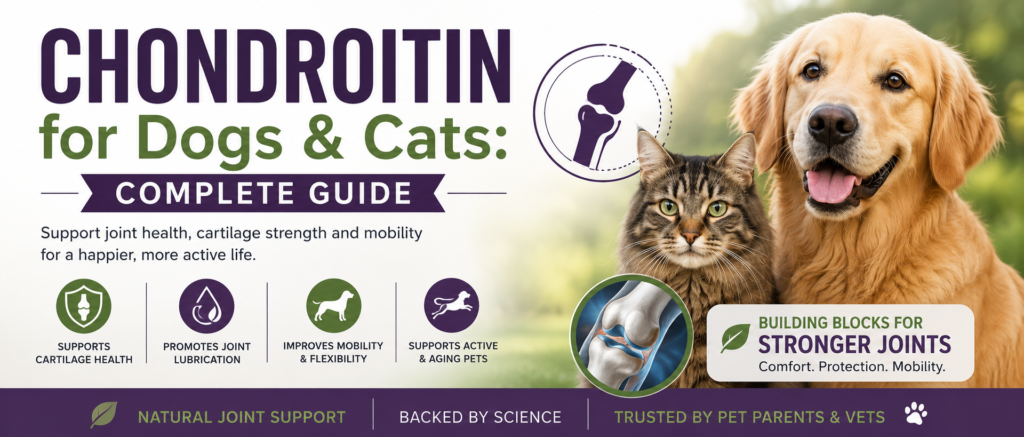
Chondroitin for Dogs & Cats: Complete Guide
What Is Chondroitin?
Chondroitin, commonly referred to as Chondroitin Sulfate, is a naturally occurring compound found within cartilage, connective tissues, bones, ligaments, and tendons throughout the body.
Cartilage acts as a protective cushion between joints, allowing bones to move smoothly without excessive friction. Chondroitin is one of the key structural components that helps cartilage maintain its elasticity, resilience, and shock-absorbing properties.
In both dogs and cats, healthy cartilage is essential for:
- Comfortable movement
- Joint flexibility
- Shock absorption
- Mobility maintenance
- Long-term musculoskeletal health
As pets age, natural cartilage breakdown may occur faster than the body’s ability to repair it. This process can contribute to stiffness, reduced mobility, and degenerative joint changes.
Because of its important role in cartilage structure, chondroitin is one of the most widely used ingredients in veterinary joint supplements.
How Does Chondroitin Work?
Chondroitin supports joint health through several biological mechanisms.
1. Supports Cartilage Structure
Cartilage is composed largely of water, collagen, and specialized molecules known as glycosaminoglycans (GAGs).
Chondroitin is a major glycosaminoglycan naturally found within cartilage.
It helps:
- Maintain cartilage integrity
- Support elasticity
- Improve shock absorption
- Promote joint resilience
Healthy cartilage allows joints to move smoothly while protecting bones from excessive wear.
2. Helps Retain Water Within Cartilage
One of chondroitin’s most important functions is attracting and retaining water molecules within cartilage tissue.
Hydrated cartilage is:
- More flexible
- Better able to absorb impact
- More resistant to mechanical stress
Without adequate hydration, cartilage may become less resilient and more vulnerable to degeneration.
3. Supports Joint Lubrication
Chondroitin contributes to maintaining the healthy environment of joints and may help support normal synovial fluid function.
Synovial fluid acts as a lubricant within joints, reducing friction during movement.
Proper lubrication is essential for:
- Comfort
- Mobility
- Joint flexibility
4. Helps Reduce Cartilage Breakdown
Research suggests that chondroitin may help inhibit certain enzymes involved in cartilage degradation.
These enzymes can contribute to the breakdown of joint tissues over time.
By supporting a healthier balance between cartilage breakdown and repair, chondroitin may help preserve joint function.
5. Supports Healthy Inflammatory Responses
Chronic inflammation plays a major role in many joint disorders.
Studies indicate that chondroitin may help support normal inflammatory pathways, contributing to improved joint comfort and mobility.
Potential Benefits of Chondroitin for Dogs & Cats
Chondroitin is commonly included in mobility and joint-health formulations due to its broad range of supportive functions.
Potential benefits may include:
Joint Support
Helps maintain healthy cartilage and connective tissue.
Improved Mobility
Supports comfortable movement and everyday activity.
Healthy Aging
Provides nutritional support for aging pets experiencing normal age-related joint changes.
Cartilage Protection
Helps support cartilage integrity and resilience.
Joint Comfort
May help support overall joint comfort and flexibility.
Active Lifestyle Support
Often used for working dogs, sporting dogs, and highly active pets.
Recovery Support
May be incorporated into rehabilitation and recovery programs under veterinary supervision.
Scientific Studies on Chondroitin
Chondroitin is among the most extensively researched joint-health ingredients used in both human and veterinary medicine.
Osteoarthritis Research
Osteoarthritis is one of the most common joint disorders affecting dogs.
Numerous studies have investigated chondroitin’s ability to support:
- Joint function
- Mobility
- Cartilage preservation
- Long-term joint health
Research generally suggests that chondroitin may help slow cartilage degradation and support overall joint wellness.
Glucosamine and Chondroitin Combination Studies
Many studies evaluate chondroitin alongside glucosamine because the two ingredients work through complementary mechanisms.
Glucosamine primarily supports cartilage synthesis, while chondroitin helps maintain cartilage structure and hydration.
This combination has become one of the most commonly used approaches in joint-support supplementation.
Veterinary Studies in Dogs
Several veterinary clinical studies have reported improvements in:
- Mobility scores
- Activity levels
- Weight-bearing ability
- Joint comfort
when chondroitin-containing supplements were used as part of long-term joint support programs.
Cartilage Preservation Research
Laboratory studies suggest chondroitin may:
- Reduce cartilage-degrading enzyme activity
- Support extracellular matrix production
- Promote cartilage health
These effects may contribute to preserving joint function over time.
What Current Evidence Suggests
Current research indicates that chondroitin may:
- Support cartilage health
- Improve mobility
- Promote joint comfort
- Help maintain healthy joint function
- Support long-term musculoskeletal wellness
Results are often most pronounced when chondroitin is used consistently over an extended period.
Food Sources of Chondroitin
Chondroitin naturally occurs in animal connective tissues.
Natural sources include:
- Cartilage
- Trachea
- Tendons
- Ligaments
- Joint tissues
- Bone-associated connective tissue
Common Dietary Sources
Foods containing naturally occurring chondroitin include:
- Beef trachea
- Chicken cartilage
- Pork cartilage
- Shark cartilage
- Fish cartilage
- Bone broth containing connective tissues
However, dietary levels are often inconsistent and difficult to standardize.
Why Supplements Are Commonly Used
Most joint supplements utilize purified chondroitin sulfate because it provides:
- Consistent potency
- Standardized dosage
- Reliable quality control
- Predictable supplementation levels
This allows veterinarians and pet owners to deliver more consistent nutritional support.
Is Chondroitin an Essential Nutrient?
No.
Chondroitin is not classified as an essential nutrient.
Dogs and cats naturally produce chondroitin within their bodies as part of normal cartilage metabolism.
Unlike vitamins, minerals, taurine, or essential fatty acids, there is no recognized dietary requirement for chondroitin.
However, supplemental chondroitin may provide additional support during periods of increased joint stress.
Signs That a Pet May Benefit from Joint Support
Although pets cannot become deficient in chondroitin itself, certain signs may indicate that additional joint support could be beneficial.
These may include:
- Stiffness after resting
- Difficulty standing up
- Reduced activity levels
- Reluctance to jump
- Slower movement
- Difficulty climbing stairs
- Decreased exercise tolerance
- Changes in gait
- Hesitation during play
- Reduced flexibility
These signs should always be evaluated by a veterinarian to determine the underlying cause.
Dosage Discussion
There is no universally established dosage recommendation for chondroitin applicable to every dog or cat.
Appropriate supplementation depends on:
- Body weight
- Age
- Activity level
- Health status
- Product formulation
- Veterinary recommendations
General Veterinary Usage Ranges
Many commercial canine joint supplements provide approximately:
Dogs
- 10–30 mg/kg body weight daily
Depending on the intended purpose and formulation.
Cats
Cats typically receive lower total amounts because of their smaller body size.
Veterinary guidance is recommended when selecting a dosage protocol.
Combination Formulas
Chondroitin is frequently combined with:
- Glucosamine
- MSM (Methylsulfonylmethane)
- Green-Lipped Mussel
- Collagen
- Hyaluronic Acid
- Omega-3 Fatty Acids
- Boswellia
- Turmeric
Combination products may provide broader support for overall joint health.
Loading and Maintenance Programs
Some joint supplements utilize:
Loading Phase
Higher amounts administered initially.
Maintenance Phase
Lower daily amounts used for ongoing support.
The specific approach varies among manufacturers and veterinary recommendations.
Veterinary Considerations
Chondroitin is generally considered safe and well tolerated in dogs and cats.
However, several factors should be considered.
Osteoarthritis Management
Joint supplements should be viewed as one component of a comprehensive mobility plan.
Veterinary management may also include:
- Weight management
- Physical rehabilitation
- Exercise modification
- Prescription medications
- Environmental adaptations
Product Quality Matters
The quality of chondroitin supplements can vary significantly.
Look for products that provide:
- Clearly stated chondroitin content
- Third-party testing
- Veterinary formulation
- Transparent ingredient sourcing
Long-Term Use
Joint-support ingredients are typically intended for long-term use.
Consistent supplementation often produces better results than intermittent use.
Senior Pets
Older pets may particularly benefit from comprehensive joint support programs that include chondroitin alongside other mobility-support ingredients.
Surgical Recovery
Veterinarians may recommend joint-support supplements during recovery from orthopedic procedures as part of a broader rehabilitation strategy.
Safety and Side Effects
Chondroitin has an excellent safety profile.
Most dogs and cats tolerate supplementation very well.
Occasional side effects may include:
- Mild digestive upset
- Soft stools
- Temporary diarrhea
- Reduced appetite
These effects are generally uncommon and mild.
Serious adverse reactions are rare.
Frequently Asked Questions (FAQs)
Can dogs take chondroitin?
Yes.
Chondroitin is one of the most commonly used joint-support ingredients for dogs and is widely included in veterinary mobility supplements.
Can cats take chondroitin?
Yes.
Cats may also benefit from joint-support supplements containing chondroitin, particularly as they age.
Is chondroitin the same as glucosamine?
No.
Although frequently used together, they perform different functions.
Glucosamine primarily supports cartilage production, while chondroitin helps maintain cartilage structure and hydration.
How long does chondroitin take to work?
Joint-support supplements often require several weeks of consistent use before noticeable improvements may occur.
Results vary between individual pets.
Can young pets use chondroitin?
Yes.
Active, working, sporting, or large-breed dogs may use joint-support supplements as part of a proactive wellness strategy.
Is chondroitin safe for long-term use?
Current evidence suggests chondroitin is generally safe for long-term supplementation when used appropriately.
Can chondroitin reverse arthritis?
No.
Chondroitin does not cure or reverse arthritis.
However, it may help support joint function, comfort, and cartilage health as part of a comprehensive management program.
Should chondroitin be given with food?
Many supplements are administered with meals to improve tolerance and simplify daily administration.
Follow the manufacturer’s feeding directions or your veterinarian’s recommendations.
Final Thoughts
Chondroitin is one of the most established and widely used ingredients for supporting joint health in dogs and cats. As a naturally occurring component of cartilage, it plays an important role in maintaining joint structure, hydration, shock absorption, and mobility.
Although it is not an essential nutrient and pets cannot become deficient in chondroitin itself, supplementation may provide valuable support for aging pets, active animals, and those experiencing normal joint wear and tear. By helping maintain cartilage integrity and supporting healthy inflammatory responses, chondroitin has become a cornerstone ingredient in modern veterinary mobility supplements.
When combined with proper weight management, regular exercise, veterinary care, and complementary joint-support ingredients such as glucosamine and omega-3 fatty acids, chondroitin can help support long-term mobility and quality of life for dogs and cats.