Housebreaking (also called housetraining or toilet training) is one of the most important developmental processes for puppies and newly adopted dogs. Despite being considered a “basic” aspect of pet ownership, inappropriate elimination remains one of the leading behavioural complaints presented to veterinarians and animal behaviour professionals. Poorly managed housetraining is also associated with increased owner frustration, breakdown of the human-animal bond, relinquishment to shelters, and long-term behavioural complications.
Many common housebreaking failures are not caused by stubbornness or “bad” dogs, but rather by preventable human mistakes involving timing, supervision, punishment, inconsistency, unrealistic expectations, and misunderstanding canine developmental physiology. Research in veterinary behavioural medicine consistently shows that positive reinforcement, structured routines, and environmental management are significantly more effective than punishment-based methods.
This article reviews the most common housebreaking mistakes new owners make, explains why these errors occur from a behavioural and physiological perspective, and outlines evidence-based strategies supported by veterinary behavioural literature and clinical guidelines.
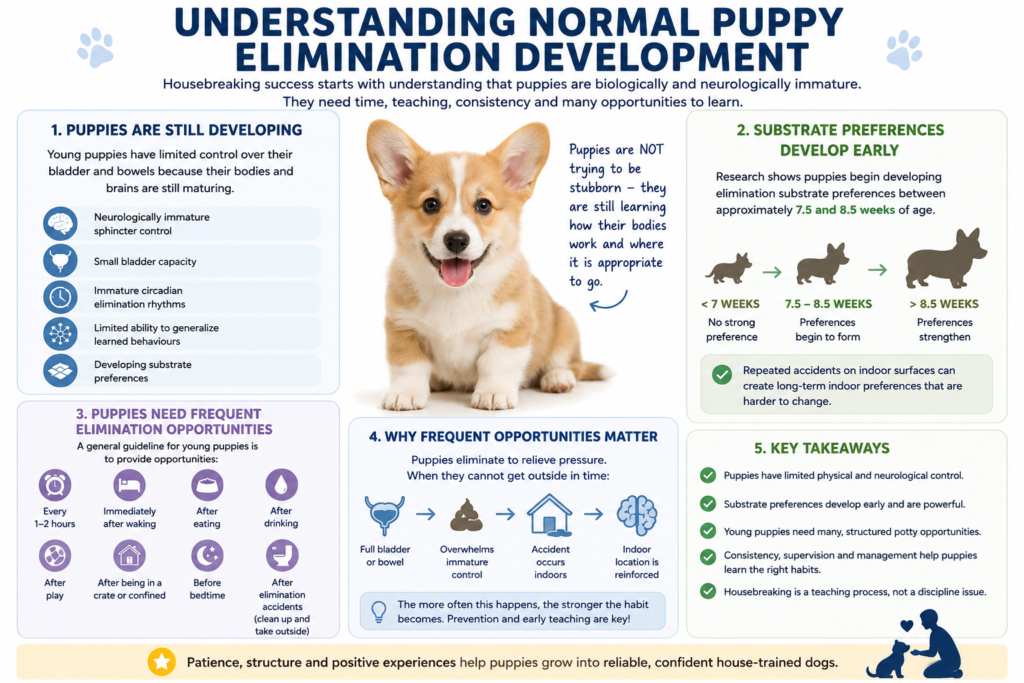
Understanding Normal Puppy Elimination Development
Before discussing mistakes, it is important to understand that young puppies are neurologically and physiologically immature.
Puppies have:
- Limited bladder and bowel control
- Underdeveloped sphincter regulation
- Immature circadian elimination rhythms
- Limited ability to generalize learned behaviours
- Developing substrate preferences (surface preferences for elimination)
Research shows puppies begin developing elimination substrate preferences between approximately 7.5 and 8.5 weeks of age.
This means:
- Puppies learn where and on what surfaces it is acceptable to eliminate
- Repeated indoor accidents can create long-term indoor preferences
- Early consistency strongly affects future success
Young puppies also need far more frequent elimination opportunities than many owners expect. Veterinary behavioural guidance commonly recommends:
- Every 1–2 hours for very young puppies
- Immediately after waking
- After eating
- After drinking
- After play
- Before bedtime
- After confinement periods
Failure to account for these biological limitations is the foundation of many housebreaking problems.
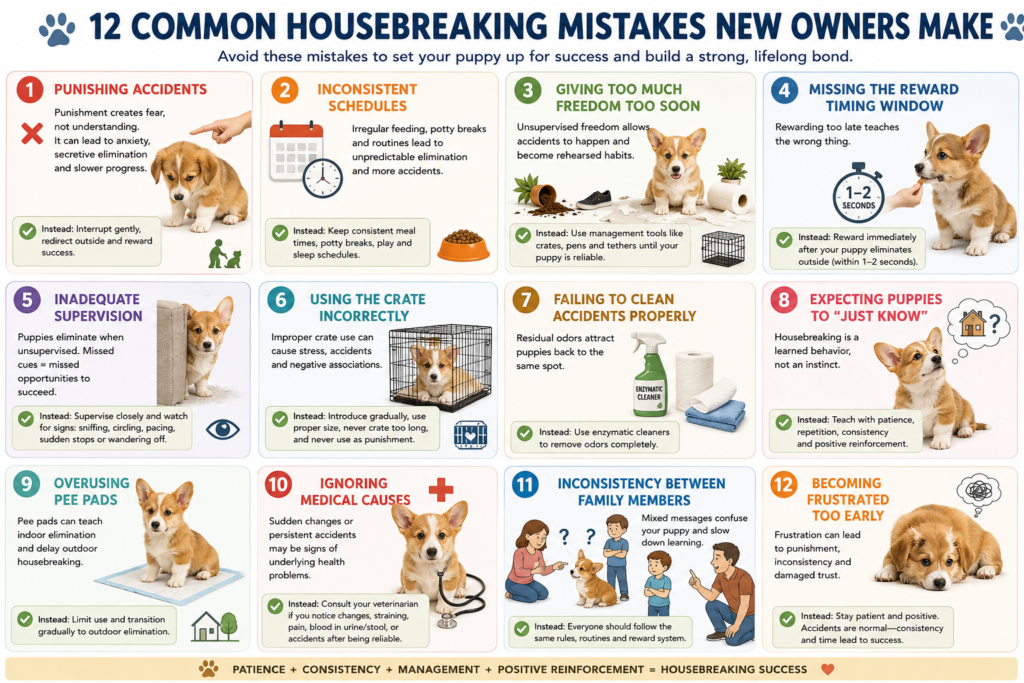
Mistake 1: Punishing Accidents
One of the most common and damaging mistakes is punishing a puppy for indoor accidents.
This includes:
- Yelling
- Hitting
- Rubbing the dog’s nose in urine or feces
- Physical intimidation
- Startling aggressively
- Punishing after the fact
Veterinary behavioural literature strongly discourages punishment-based housetraining.
Why Punishment Fails
Dogs do not interpret punishment the way humans often assume.
Instead of learning:
“Indoor elimination is wrong”
many puppies learn:
“Humans are dangerous when I eliminate”
This distinction is critical.
Research and behavioural case reports show punishment can lead to:
- Fear during elimination
- Secretive elimination
- Anxiety around owners
- Elimination only when unobserved
- Stress-related behavioural problems
- Reduced communication signals
Some dogs become so anxious they hide behind furniture or wait until owners leave the room before eliminating.
The IAABC Foundation notes that even seemingly mild corrections such as clapping, gasping, or startling can create elimination anxiety in sensitive puppies.
Evidence-Based Alternative
Instead of punishment:
- Interrupt gently if caught in the act
- Calmly redirect outdoors
- Reward immediately after successful outdoor elimination
Positive reinforcement creates a clear behavioural association:
Outdoor elimination = reward
This method is supported by veterinary behavioural medicine and humane training guidelines.
Mistake 2: Inconsistent Schedules
Dogs learn patterns extremely effectively. Inconsistent schedules create inconsistent elimination habits.
Common owner mistakes include:
- Random feeding times
- Irregular walks
- Variable wake times
- Inconsistent bedtime routines
- Sporadic outdoor access
Why Schedules Matter
Scheduled feeding creates predictable gastrointestinal activity.
Veterinary behavioural guidance recommends feeding on consistent schedules rather than free-feeding because:
- Predictable intake produces predictable elimination timing
- Owners can better anticipate potty breaks
- Puppies learn routine faster
Free-feeding (constant food access) often results in:
- Unpredictable bowel movements
- Increased accidents
- Difficulty identifying elimination windows
Evidence-Based Recommendation
Successful housetraining usually involves:
- Fixed meal times
- Scheduled potty breaks
- Consistent sleep schedules
- Repeated use of the same elimination area
Predictability reduces learning complexity for puppies.
Mistake 3: Giving Too Much Freedom Too Soon
Many new owners allow puppies unrestricted home access before reliable housetraining is established.
This is one of the fastest ways to create repeated indoor elimination habits.
Why This Causes Problems
Every indoor accident reinforces:
- The location
- The substrate
- The behavioural habit
Elimination itself is self-reinforcing because it relieves bladder or bowel pressure.
When puppies repeatedly eliminate indoors:
- The behaviour becomes practiced
- Odours remain
- Surface preference develops
- Learning is prolonged
Recommended Environmental Management
Behavioural specialists commonly recommend:
- Tethering (“umbilical cord training”)
- Crates
- Exercise pens
- Restricted room access
- Constant supervision
Close supervision allows owners to recognize:
- Circling
- Sniffing
- Squatting
- Wandering away
- Sudden stillness
These are common pre-elimination behaviours.
Mistake 4: Missing the Reward Timing Window
Timing is one of the most misunderstood aspects of dog learning.
Many owners reward puppies:
- After returning indoors
- Minutes after elimination
- After the walk ends
However, dogs associate rewards with behaviours occurring within a very short time window.
Why Timing Matters
To create strong learning associations:
- Reward must occur immediately after elimination
- Ideally within 1–2 seconds
If owners wait too long, puppies may associate rewards with:
- Returning indoors
- Sitting
- Approaching the owner
- Walking to the door
instead of the actual elimination behaviour.
Animal welfare and humane society guidance consistently emphasizes immediate reinforcement timing.
Best Practice
The sequence should be:
- Puppy eliminates outdoors
- Immediate praise
- Immediate high-value treat
- Optional playtime afterward
This creates clear behavioural reinforcement.
Mistake 5: Inadequate Supervision
Many owners underestimate how actively puppies must be supervised.
Housebreaking failures commonly occur because:
- Puppies wander out of sight
- Owners are distracted
- Puppies are unsupervised after meals
- Owners miss subtle body language
Why Supervision Is Critical
Puppies often show subtle elimination signals:
- Sniffing
- Circling
- Sudden pacing
- Seeking corners
- Moving away from activity
Without supervision, owners lose opportunities to:
- Interrupt accidents
- Redirect appropriately
- Reinforce outdoor success
Veterinary behavioural guidance repeatedly identifies supervision as a core housetraining principle.
Mistake 6: Using the Crate Incorrectly
Crate training can be highly effective when done correctly, but harmful when misused.
Common Crate Mistakes
Crating Too Long
Young puppies cannot “hold it” for extended periods.
Excessive confinement may force puppies to:
- Eliminate inside the crate
- Lose natural den cleanliness
- Develop distress
- Associate crates with fear
Using the Crate as Punishment
This creates negative emotional associations.
Forcing Anxious Dogs Into Crates
Some dogs develop confinement anxiety or separation anxiety.
Signs include:
- Panting
- Salivation
- Vocalization
- Escape attempts
- Trembling
Repeated forced confinement may worsen anxiety disorders.
Evidence-Based Crate Use
Proper crate training involves:
- Gradual introduction
- Positive associations
- Appropriate sizing
- Frequent bathroom breaks
- Never exceeding developmental limitations
Veterinary behavioural literature emphasizes that crate training should prioritize emotional comfort, not merely containment.
Mistake 7: Failing to Clean Accidents Properly
Dogs possess highly sensitive olfactory systems.
Residual urine odours strongly encourage repeat elimination in the same location.
Common Cleaning Errors
Owners often use:
- Bleach
- Soap
- Ammonia products
- Standard household cleaners
These may fail to eliminate odour compounds completely.
Some ammonia-based cleaners may even mimic urine scent chemically.
Evidence-Based Cleaning Recommendations
Veterinary and humane training resources recommend:
- Enzymatic cleaners
- Odour-neutralizing cleaners
- Thorough saturation of contaminated areas
Proper cleaning reduces:
- Resoiling behaviour
- Learned indoor preferences
- Persistent accidents
Mistake 8: Expecting Puppies to “Just Know”
Many owners assume puppies naturally understand that outdoors is the correct bathroom location.
This is incorrect.
Dogs naturally avoid soiling sleeping areas, but they do not inherently understand:
- Human homes
- Carpet rules
- Outdoor expectations
- Door locations
American Humane specifically notes that outdoor elimination is a learned behaviour, not an instinctive one.
Learning Requires Repetition
Puppies learn through:
- Repetition
- Consistency
- Reinforcement
- Predictability
Housebreaking is therefore a teaching process, not a discipline process.
Mistake 9: Overusing Pee Pads
Pee pads can be useful in:
- High-rise apartments
- Severe weather
- Limited outdoor access
- Medical situations
However, improper use can delay outdoor housetraining.
Why Problems Occur
Pee pads may unintentionally teach:
- Indoor elimination is acceptable
- Soft absorbent surfaces are toilet areas
This may generalize to:
- Rugs
- Carpets
- Mats
- Bedding
Because puppies form substrate preferences early, prolonged pee pad use can complicate transition outdoors.
Best Practice
If pee pads are used:
- Keep location consistent
- Transition gradually outdoors
- Reinforce outdoor elimination heavily
- Avoid allowing access to multiple soft surfaces
Mistake 10: Ignoring Medical Causes
Not all housebreaking failures are behavioural.
Persistent or sudden house-soiling may indicate medical disease.
Potential Medical Causes
Veterinary sources identify several medical contributors:
- Urinary tract infections
- Gastrointestinal disease
- Parasites
- Congenital abnormalities
- Incontinence
- Diabetes
- Pain disorders
- Cognitive dysfunction
- Mobility disorders
Red Flags Requiring Veterinary Evaluation
Owners should seek veterinary care if a puppy:
- Suddenly regresses
- Strains to urinate
- Has diarrhea
- Urinates excessively
- Appears painful
- Dribbles urine continuously
- Cannot hold urine appropriately for age
- Has blood in urine or stool
Medical causes must be ruled out before assuming behavioural failure.
Mistake 11: Inconsistency Between Family Members
Dogs learn poorly when household rules vary.
Common inconsistencies include:
- Different potty cue words
- Different feeding schedules
- Variable reward systems
- Some people allowing accidents
- Mixed discipline styles
This creates confusion and slows learning.
Evidence-Based Recommendation
Successful housetraining works best when:
- Everyone uses the same routine
- Everyone reinforces the same behaviour
- Everyone follows identical rules
Consistency dramatically accelerates behavioural acquisition.
Mistake 12: Becoming Frustrated Too Early
Housebreaking is developmental.
Accidents are expected.
Realistic Expectations
Most puppies are not fully reliable until several months of age.
Factors affecting training speed include:
- Age
- Breed
- Previous experiences
- Owner consistency
- Environment
- Anxiety levels
- Medical status
Research and humane society guidance repeatedly emphasize patience and consistency.
Punishment and frustration often prolong learning rather than accelerate it.
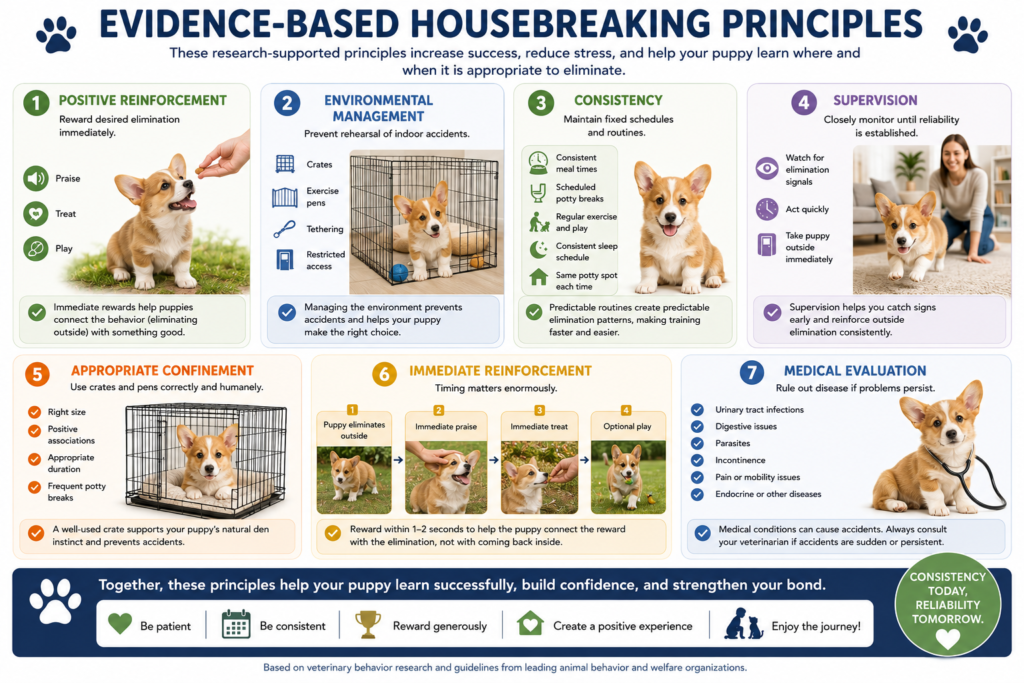
Evidence-Based Housebreaking Principles
The veterinary behavioural consensus strongly supports these principles:
1. Positive Reinforcement
Reward desired elimination immediately.
2. Environmental Management
Prevent rehearsal of indoor accidents.
3. Consistency
Maintain fixed schedules and routines.
4. Supervision
Closely monitor until reliability develops.
5. Appropriate Confinement
Use crates and pens correctly and humanely.
6. Immediate Reinforcement
Timing matters enormously.
7. Medical Evaluation
Rule out disease if problems persist.
These approaches are consistently supported across veterinary behavioural medicine literature and humane training organizations.
Final Thoughts
Most housebreaking mistakes stem from misunderstanding normal puppy behaviour rather than owner negligence. Puppies are not born understanding human household rules, and they require structured teaching, consistency, supervision, and reinforcement to succeed.
Modern veterinary behavioural science strongly supports humane, reward-based housetraining methods while discouraging punishment, intimidation, and unrealistic expectations. Dogs trained through predictable routines and positive reinforcement generally develop stronger long-term reliability, lower anxiety, and healthier human-animal relationships.
Importantly, persistent house-soiling should never automatically be interpreted as stubbornness or defiance. Medical disease, anxiety, developmental limitations, environmental inconsistency, and inappropriate training methods must all be considered.
When owners approach housebreaking as a developmental learning process rather than a disciplinary issue, outcomes are typically faster, more reliable, and significantly less stressful for both dog and human.
References
- Shalvey E, et al. Exploring the understanding of best practice approaches to common dog behaviour problems by veterinary professionals. Animals. 2019.
- UC Davis Veterinary Medicine. Housetraining Your Puppy.
- Edmonton Humane Society. Dog Behaviour Guide: House Training.
- Tynes VV. Canine Housetraining Challenges. DVM360.
- IAABC Foundation Journal. All the Worst Puppy Problems: Housetraining Hang-Ups.
- American Humane. Housetraining Puppies & Dogs.
- Today’s Veterinary Practice. Canine House Soiling: Back to Basics.
- Vetwest Animal Hospitals. House Soiling – Elimination and Marking Problems in Dogs.
- VIN (Veterinary Information Network). Elimination Behavior Problems in Dogs.